Colorado’s PDAB Experiment
What should Colorado patients expect when the Prescription Drug Affordability Board sets upper payment limits?
Patients Deserve Better Than a Price-Setting Experiment.
Colorado is about to implement new health care policy. But it comes with major risks.
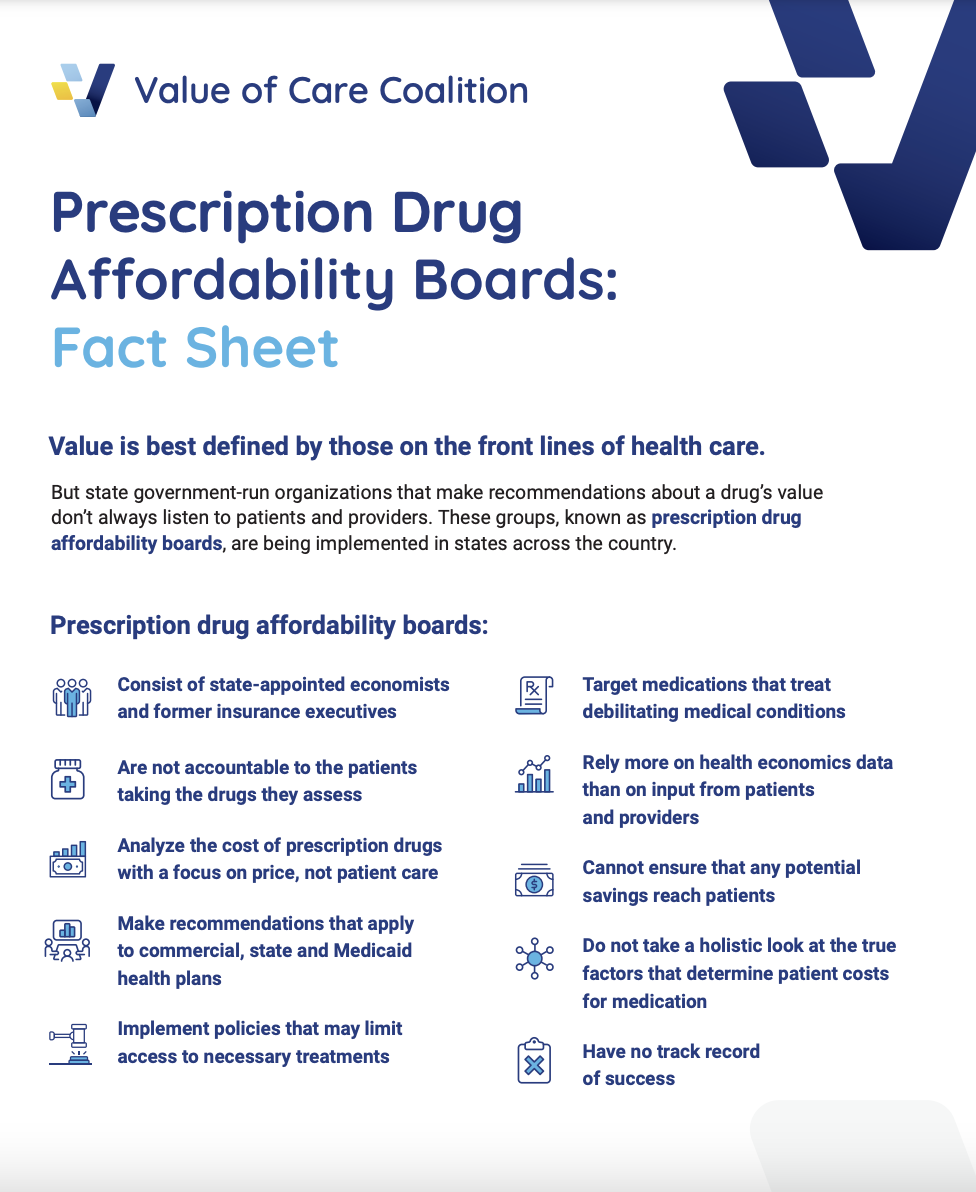
The Colorado Prescription Drug Affordability Board (PDAB) is setting a price cap called an upper payment limit (UPL) on certain drugs sold within the state. They’re bringing prices set in Washington, DC to Colorado. And they’re doing it as a so-called affordability solution.
But UPLs don’t guarantee any meaningful savings for patients. Instead, they risk higher costs and reduced access to the very treatments patients rely on.
Learn More
Sign Up for More Information About Colorado’s Price-Setting Experiment
What Experts Are Saying.
Health care supply chain experts are telling us what government price caps will do. Here’s what they’re saying.
PATIENTS
The EACH / PIC patient-led survey makes clear: affordability is not just about the price of a single drug – it’s about the total burden of care.
– Even 20% of respondents paying $0–$10/month said their medications were still unaffordable, citing other financial pressures and cumulative costs.
– 77% reported additional out-of-pocket medical costs – for doctor visits, imaging, labs, and assistive devices – that compound the strain.
– When patients said a drug was “unaffordable,” 100% who discontinued it cited insurance barriers (denials, step therapy, prior authorization) – not just cost alone.
DOCTORS
A Value of Care Coalition survey of specialists found:
– 93% did not believe there was sufficient knowledge-sharing between PDABs and health care providers.
– 100% feared PDAB decisions would increase administrative work and cut into patient care.
– 96% expressed concern that UPLs will lead to non-medical switching—forcing patients off effective medications for reasons unrelated to health.
PHARMACISTS
The National Community Pharmacists Association has warned that “a third of independent pharmacies won’t carry drugs subjected to Medicare’s maximum fair price, and another 60% are considering not stocking those drugs.”
HEALTH PLANS
According to research conducted by Avalere for the Partnership to Fight Chronic Disease, upper payment limits raise patient costs:
– 50% of health plans expect increased copays or coinsurance on drugs with upper payment limits.
– 57% anticipate increasing premiums if upper payment limits are implemented.
RESEARCHERS
Experience with federal drug price controls, Medicare’s Maximum Fair Price (MFP) program, is already showing negative patient impacts:
– An analysis from the Pioneer Institute shows Patient costs for drugs subjected to federal price controls have seen an average 32% increase in out-of-pocket costs.
– According to the Schaeffer Institute at USC, health plans are implementing sharp increases in annual deductibles and shifting benefit design from flat copays toward coinsurance, forcing patients to pay a percentage of the list price instead of a predictable dollar amount.
A Better Path Forward.
Stakeholders across the health system agree: UPLs are not the solution.
Real affordability requires:
✔ Benefit design reform that lowers costs at the pharmacy counter.
✔ Transparency in formularies and PBM rebates so savings reach patients.
✔ Policies that protect access to the medicines doctors prescribe and patients depend on.
PUT PATIENTS FIRST
Patients should never be test subjects in a government price-setting experiment. PDABs should reject upper payment limits and pursue real solutions that protect access, improve outcomes, and deliver savings directly to patients.
Learn More
Sign Up for More Information About Colorado’s Price-Setting Experiment
Resources
Videos
Fact Sheets